In the rigorous world of Lean manufacturing, "inventory" has long been treated as one of the cardinal wastes. The philosophy of pioneers like Taiichi Ohno, the Father of Lean Principles, taught generations of manufacturers to relentlessly pursue the reduction of inventory to expose operational problems and slash costs. Yet, as the fragility of global supply chains becomes a daily headline, running with near-zero buffer stock is no longer a sign of efficiency; it's a high-stakes gamble. This creates a critical paradox for today's manufacturing leaders: how do you stay true to the principles of Lean and avoid wasteful excess while also being resilient and prepared for inevitable disruption?
The answer lies in evolving the concept of inventory from a liability to a strategic asset. The goal is not to simply hold more inventory, but to hold smarter inventory. This means creating a buffer that is precisely calculated, perfectly managed, and seamlessly integrated with your production flow. The tools to achieve this sophisticated balance are automated storage systems and Automated Guided Vehicles (AGVs). This powerful combination allows you to create a strategic, data-driven buffer that provides a critical safety net without abandoning the core principles of Lean flow. The adoption of these tools is accelerating for this very reason, with 65% of warehouse operators planning to increase their investment in automation in the next two years.
Automated Storage: The Foundation of the Smart Buffer
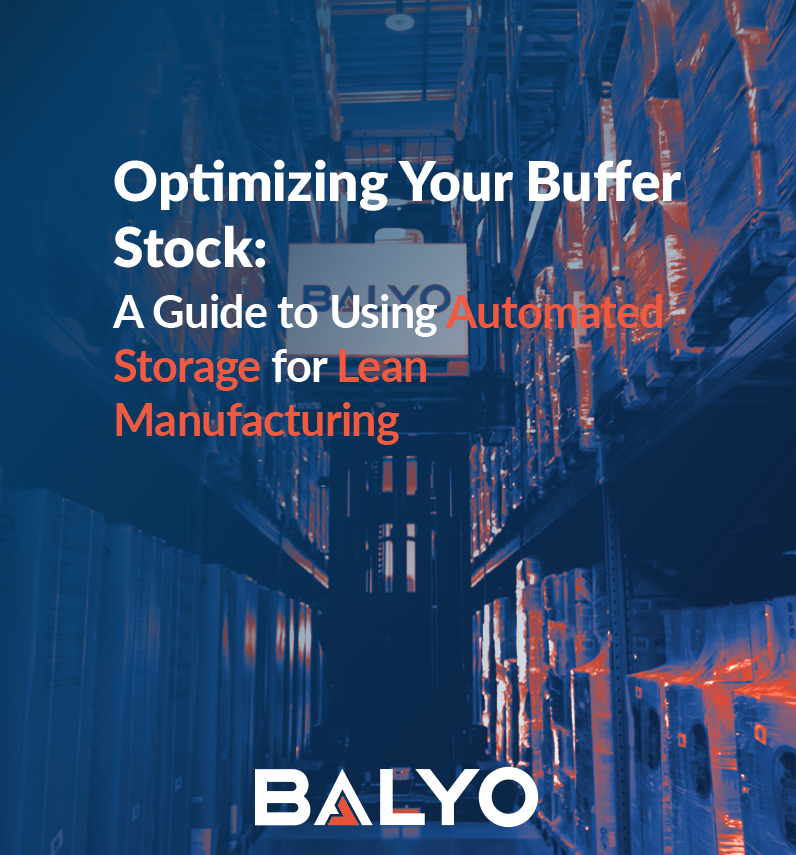
A traditional warehouse with manual forklifts and standard racking is a poor place to hold a strategic buffer. Space is used inefficiently, inventory can easily get lost or damaged, and ensuring proper stock rotation using a First-In, First-Out (FIFO) system is a constant, error-prone challenge. High-denisty racking, where autonomous Very Narrow Aisle robotic forklifts can act as an affordable and mobile AS/RS, serves as the foundation for a smart “buffer.”
Maximum Density, Minimum Footprint: The primary benefit of a high-density racking area with VNA robots is its incredible space efficiency. This area can store a massive amount of buffer stock in a fraction of the floor space required by a conventional warehouse. This avoids the need for costly off-site storage or facility expansions.
Software-Driven Inventory Management: The Warehouse Execution System (WES) that controls this high-density zone is the key to optimization. It is far more than a simple location database; it's an active management tool. It tracks the age of every single pallet and can be programmed to strictly enforce FIFO, ensuring that your buffer stock is always fresh and rotated correctly to prevent obsolescence. This is critical, as inventory carrying costs can amount to 20-30% of the inventory's total value annually.² The WES eliminates the risk of this waste by design. It can also use "dynamic slotting" logic, placing fast-moving items or those scheduled for upcoming production runs closer to the output stations for the quickest possible retrieval.
This transforms your buffer from a disorganized, costly pile of "just-in-case" inventory into a highly organized, data-rich strategic asset. It allows you to make precise, data-driven decisions about your buffer levels, perfectly balancing the cost of holding inventory against the immense cost of a production-stopping stockout.
The Second Line of Defense
Holding a smart buffer is only half the battle. You must be able to connect that buffer to your production line in a way that still adheres to the core Lean principle of "flow." You don't want to undermine your resilience strategy by dumping a week's worth of inventory on the production floor; you want to pull only what you need, exactly when you need it. This is the crucial role of other AGVs like autonomous reach trucks, stackers, and tuggers.
These robots working in concert act as the lean, on-demand transport layer between your smart buffer (high-density VNA aisles) and your point of use (the production line). The synergy creates a "best of both worlds" system:
- Enabling Digital "Pull" Signals: The system operates on a "pull" basis, the cornerstone of JIT. When a workstation on the assembly line begins to run low on a specific component, it sends a digital "kanban" or call to the WES.
- Just-in-Time Retrieval and Delivery: The WES receives this signal and instantly orchestrates the response. It directs the VNA to retrieve the required pallet and simultaneously dispatches the closest available AGV to the end of the aisle. The AGV picks up the pallet and delivers it directly to the designated workstation, often arriving just minutes before the last of the old stock is consumed.
- Handling Heavy Industry Demands with Lean Principles: This synergy is especially critical in heavy manufacturing. Imagine a production line that needs a 5-ton pallet of stamped metal parts. Manually retrieving this from a buffer warehouse is a slow, cumbersome process that is the opposite of lean. In an automated system, a heavy-duty AGV is dispatched to the high-density zone and delivers this massive payload to the line with the same JIT precision as a small box of screws.
This process allows you to have the security of a well-managed buffer stock and the hyper-efficiency of a JIT delivery system. It’s the core principle of the agile warehouse.
Achieving Lean Resilience
The old view that a manufacturer must make a hard choice between being lean or being resilient is a false dichotomy created by the limitations of manual processes. By leveraging the power of automated storage to create an optimized, data-driven buffer and a fleet of intelligent AGVs to provide a lean, just-in-time connection to production, manufacturers can finally achieve both. This strategic, integrated approach allows you to minimize waste and maximize efficiency while ensuring your operation has the robust resilience to thrive in the face of modern supply chain challenges.
Citations
MHI & Deloitte, "Transforming the supply chain: The innovation imperative," 2024 MHI Annual Industry Report. https://www.mhi.org/publications/report ² Investopedia, "Inventory Carrying Costs," 2024. https://www.investopedia.com/terms/c/carrying-costs.asp