
<img alt="" src="https://secure.data-insight365.com/265670.png" style="display:none;visibility:hidden">

LOAD MANAGEMENT

01 TRUCK IDENTIFICATION
_________________________________________________________________________________________________________________________
Establishing a Connection Between the Robot and Its Environment

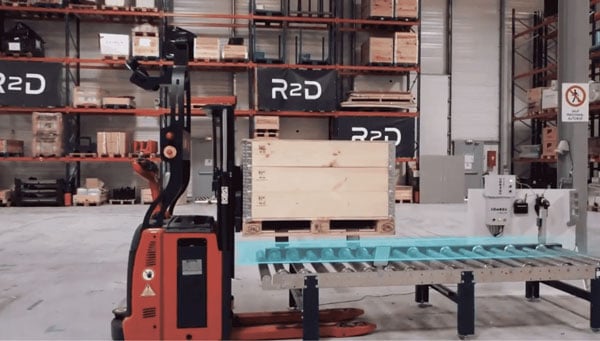
The transport of goods must be carried out with care. BALYO has developed the best algorithms to precisely calculate the location and position of autonomous vehicles—with a single goal in mind: the cargo. While accuracy isn’t always guaranteed during manual operation, BALYO’s relative algorithm detects obstacles around the vehicles and guides the robot precisely to the correct pickup or drop-off point.

Thanks to a recognition algorithm, the robot uses information from the 3D camera to convert it into a recognizable 3D model of the object. This feature allows us to monitor the relative distance to the object at every step of picking up or setting down a load. All available 3D information is compared with the digital 3D model of the object, which was previously stored in the robot’s memory.

image d'un chariot qui charge des éléments

02 LOAD IDENTIFICATION
_________________________________________________________________________________________________________________________
Tracking and Processing the Correct Shipment

Traceability of shipments throughout your operations ensures that the entire process is followed and complies with regulations.


By integrating a barcode reader that is connected to our system, our robots can read various common barcode formats, such as 2/5 Interleaved, Codabar, Data Matrix ECC200, and QR Code. The information is retrieved and transmitted to the robot manager and can be used to trigger specific actions. An ERP/WMS system can thus request the transport of an identifiable load, which the robot verifies before executing its task.

03 CONTROL
_________________________________________________________________________________________________________________________
Monitoring Procedures

Various checks are performed during a robotic mission. Load verification reduces the risk of a load falling during transport or pickup. Verification and control are carried out through a combination of hardware components, mission logic, and software functions. These processes are used to assess the following aspects:

aspect-ratio

Measurement

Recording and evaluation of the height and width of the load

alert-triangle (1)

Control of Skidding and Sliding

Assessment of the risk of cargo slippage on a specific infrastructure

radar-2

Space Check

Checking the remaining space before storing a pallet on a shelf

forklift

Slip Control

Monitoring and Ensuring Load Stability While Driving

Uninterrupted communication between the robot manager and the robots ensures that the mission is carried out satisfactorily and leads to the mission being terminated as soon as a risk is detected.

ARE YOU LOOKING FOR A DEAL?

Get in touch with us and find out if your project is feasible today!
Contact Us