When speaking with manufacturing leaders, we find efficiency improvements and rapid ROI to be the primary drivers for robotic automation. However, the true adoption of technologies like Automated Guided Vehicles (AGVs) or an entire autonomous mobile robot fleet only happens with the utmost assurance of safety.
The reality is that navigating a multi-ton autonomous vehicle through a dynamic human/robot environment requires more than just smart programming. It demands a meticulously engineered, deeply integrated safety system. This system is the result of combining perception sensors, intelligent software, and fail-safe hardware.
The confidence you have in the safety of the fleet is directly tied to understanding these layered redundancies.
An AGV forklift perceives its environment through a constant, 360° stream of precise data that is fundamentally more reliable and comprehensive than manual operator perception. Robotic perception is built upon a foundation of overlapping sensor technologies, all governed by a safety-rated control system that adheres to strict international standards. This article provides a technical deep dive into the core components that make these collaborative robots a safe and viable reality. The rapid adoption of these components is evident in the market growth; the global LiDAR market, a cornerstone of this technology, is projected to reach $6.3 billion by 2030 as industries from automotive to logistics depend on it for safe autonomy.1
The Primary Perception Layer: LiDAR and Curtain Lasers
LiDAR (Light Detection and Ranging) is the undisputed workhorse of autonomous navigation and safety. Its function is to provide a meticulously accurate point cloud map of the vehicle's surroundings.
- Principle of Operation: A LiDAR unit emits thousands of invisible laser pulses per second. It measures the precise time it takes for these pulses to reflect off objects and return to the sensor. From this time-of-flight data, it calculates an exact distance, creating a real-time, millimeter-accurate 3D "point cloud" of the environment. An automated forklift will typically use multiple LiDAR sensors for redundancy and complete coverage:
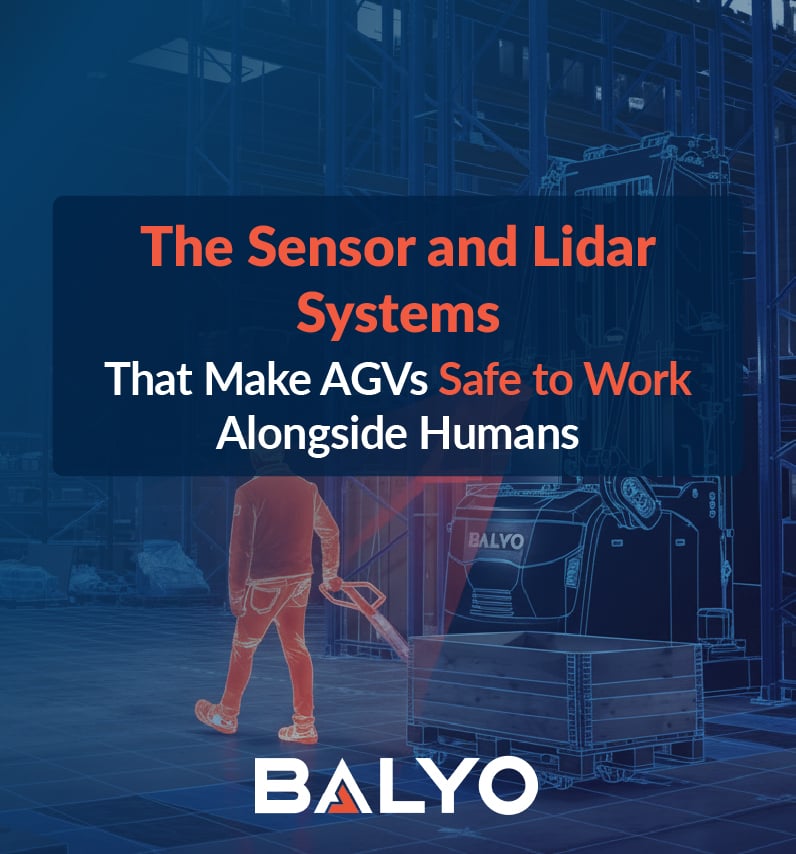
- Navigation and Safety LiDAR: Typically mounted high on the robot chassis, this sensor is used for localization. Its point cloud is constantly compared to a pre-loaded digital map of the facility, allowing the AGV to know its exact position and orientation at all times. In addition, this powerful sensor recognizes obstacles that come into its path. It is certified to meet specific safety standards, like ANSI, ISO, and CE. This sensor is programmed with configurable safety fields, typically a wider "warning" field and a narrower "stop" field that detects objects on the ground and at height. If an object, such as a person's legs, enters the warning field, the AGV's control system is programmed to slow down. If the object penetrates the inner stop field, the system triggers an immediate but controlled emergency stop.
- Curtain Lasers: Four strategically placed lasers at the base of the AGV cover any blind spots that the primary LiDAR can’t see. They offer the same protections at ground level, slowing down or stopping the vehicle if an object is in its path.
- Key Engineering Advantages: LiDAR is exceptionally precise, and its performance is not degraded by ambient lighting conditions, making it perfectly reliable in dimly lit warehouses or during 24/7 "lights-out" operations.

The Secondary Safety Layer: Pallet Pick and Drop Perfection
While LiDAR provides the geometric map ("where" an object is) and crucial context ("what" an object is) along with the curtain lasers while the vehicle is in transit, there’s an equal amount of safety precision that happens when the vehicle is interacting with pallets.
- Pallet Camera: An advanced camera that identifies pallet type and condition. This camera tells whether a pallet is there, what type of pallet it is, and most importantly, whether the pallet is structurally sound for picking from its current location..
- Distance Laser: A depth perception indicator that tells the robot the precise distance between the mast and the pallet. This device is a consistent measurement to ensure the pallet is firmly secured on the forks.
The fusion of LiDAR and vision data creates a perception system that is far more robust and reliable than any single technology could be on its own. It is a cornerstone of the collaborative ("cobot") philosophy.
The Tertiary Layer: Fail-Safe Hardware
The final layers of the safety system involve direct physical sensors and the core control hardware.
- The Safety-Rated PLC: All of this sensor data is processed and acted upon by the vehicle's central control system, which is built around a safety-rated PLC (Programmable Logic Controller) and safety relays. This is the critical difference between an industrial robot and a simple machine. It is designed to meet strict international standards like ISO 13849-1, achieving a Performance Level d (PLd) rating. This means it is designed with dual-channel architecture, redundant processors, and self-monitoring diagnostics. It constantly cross-checks the data from the different sensors and is programmed to adhere to a simple, overriding command: if there is any uncertainty, conflicting data, or component failure, default to the safest possible state, which is a controlled stop.
This uncompromising, multi-layered, and redundant engineering is what allows a solutions design engineer to confidently deploy these autonomous systems in a human-centric environment, as we detail in our main guide, The Manufacturer and Warehouse Guide to Improving Employee Safety.
Citations
1 MarketsandMarkets, "Lidar Market," 2024. https://www.marketsandmarkets.com/Market-Reports/lidar-market-1261.html