For decades, Just-in-Time (JIT) has been the celebrated ideal of Lean manufacturing. In a perfectly stable world, the JIT principle of holding minimal inventory is the pinnacle of efficiency. However, the last several years have served as a brutal stress test for global supply chains. An overwhelming 94% of Fortune 1000 companies have experienced significant disruptions, proving that a purely lean, JIT-reliant model is dangerously fragile.¹ Efficiency is no longer enough. The new imperative is resilience—the ability to absorb shocks and maintain operational continuity.
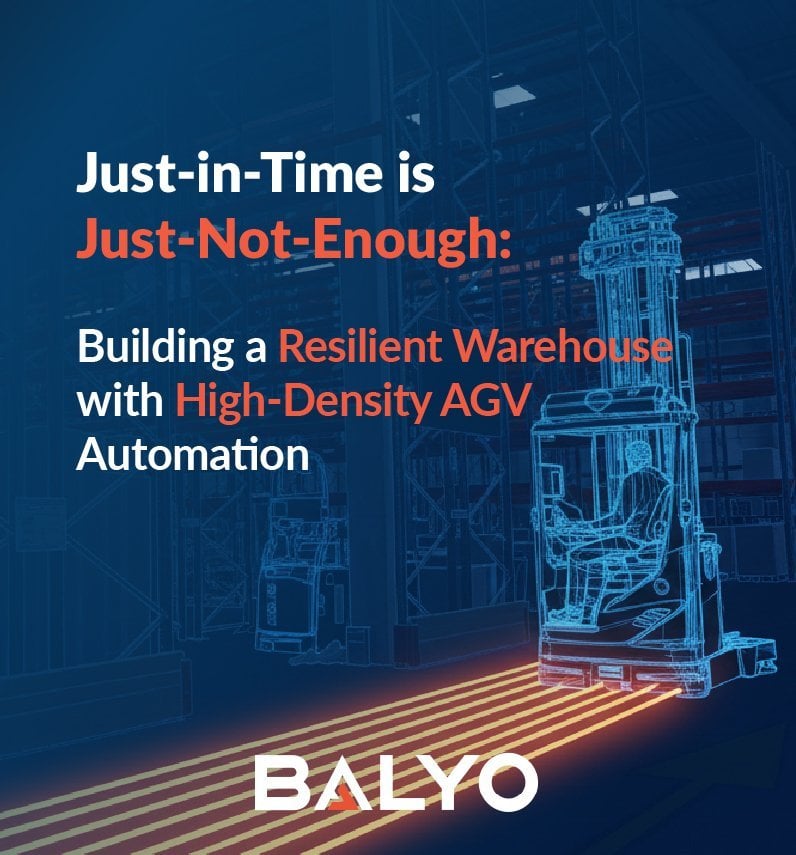
This doesn’t mean abandoning Lean principles; it means evolving them. The key is to build a "smart buffer" of critical on-site inventory. While massive, fixed Automated Storage and Retrieval Systems (AS/RS) represent the ultimate in storage density, their high cost and extensive infrastructure requirements can be prohibitive. Fortunately, there is a more agile and accessible path: leveraging a fleet of modern Automated Guided Vehicles (AGVs), specifically Very Narrow Aisle (VNA) AGVs, to act as the mobile and flexible AS/RS.

VNA AGVs: The Mobile and Flexible AS/RS
The most significant barrier to holding an effective buffer stock is physical space. A traditional warehouse, with wide aisles designed for manual forklifts, is an inefficient use of a building's footprint. This is the problem the VNA AGV was born to solve.
- Radically Increasing Storage Density: A standard autonomous forklift requires an aisle width of 12 to 13 feet to maneuver. A VNA AGV, however, is designed to operate in aisles as narrow as 6 ½ feet. This simple geometric advantage has a massive impact. By converting a standard warehouse layout to a VNA configuration, an organization can increase its total storage capacity by up to 50% within the exact same building footprint.² This allows for the creation of a substantial on-site buffer without the immense cost of new construction.
- Utilizing Full Vertical Height: VNA AGVs are not just for narrow spaces; they are high-reach machines. These automated vehicles can precisely and safely place and retrieve pallets from racking that is up to 56’ high, utilizing every inch of your building's expensive vertical cube.
This combination of aisle reduction and high-reach capability delivers the primary benefit of an AS/RS—tremendous storage density—but with far greater flexibility and a significantly lower initial capital investment. It is a powerful, pragmatic approach to building resilience.
How VNA AGVs Create a Resilient, On-Demand Buffer
Creating a dense storage area is only half the battle. To be truly resilient, that buffer must be instantly accessible and seamlessly integrated with production. This is where the automated nature of VNA AGVs provides a decisive advantage over manual VNA operations.
- Precision, Safety, and Speed at Height: Operating a manual lift truck in a tight, 50-foot-high aisle is a slow, difficult, and high-stress task. An AGV performs this task with robotic precision and confidence every time. Guided by LiDAR and integrated with the Warehouse Management System (WMS), it can retrieve a specific pallet from the highest rack level with speed and perfect accuracy, eliminating the risk of human error and dramatically increasing cycle times.
- 24/7 Reliability for Uninterrupted Flow: Supply chain needs don't adhere to a 9-to-5 schedule. An AGV fleet can operate around the clock with minimal supervision, building up the buffer stock during off-shifts and pulling from it to feed production lines overnight or on weekends, ensuring absolute continuity.
- Flexibility and Scalability: Unlike the fixed infrastructure of an AS/RS, an AGV system is inherently flexible. As your business needs change, you can easily scale your operation by adding more vehicles to the fleet. If you reconfigure a section of your warehouse, the AGV's navigation map can be updated in software, a task far simpler and cheaper than modifying a massive steel AS/RS structure.
This powerful combination of density, precision, and flexibility is the core of a resilient operation. To understand the full scope of this integrated approach, explore our main pillar page, The Agile Manufacturing Warehouse.
Resilient, Dense, and Attainable
The narrative that building a resilient supply chain requires a billion-dollar overhaul with massive, fixed automation is a myth. For many manufacturers, the most intelligent path is to maximize the assets they already have. By converting to a high-density layout and deploying a fleet of VNA AGVs, an organization can achieve the vast majority of the storage benefits of an AS/RS in a more scalable, flexible, and financially accessible way. This approach allows you to build a supply chain that finally resolves the paradox: one that is lean in its execution, but robust and resilient by design.
Citations
¹ Accenture, "Supply Chain Disruption," 2023. https://www.accenture.com/us-en/insights/consulting/supply-chain-disruption
² Material Handling & Logistics (MH&L), "Making the Case for Very Narrow Aisle Forklifts," 2024. https://www.mhlnews.com/warehousing/article/21282247/making-the-case-for-very-narrow-aisle-forklifts